
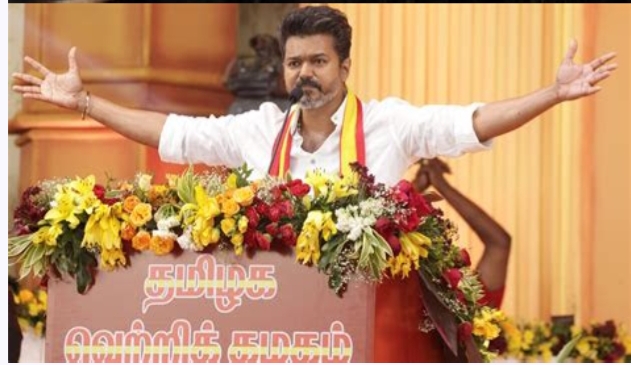
The Outlier Who Shattered Tamil Nadu’s Dravidian Order – meet Chandrasekharan Joseph Vijay

By TN Ashok.
Chennai
May 05, 2026
youtube.com/@theflagpost
He is the heartthrob of every youth — 18 to 40 adore him — he is neither good looking or handsome in the filmy sense, but has a powerful screen presence and women adore him for his dancing styles. Not a great speaker but his resonance with the youth was electric.
For seventy years, Tamil Nadu’s politics was a closed script. The duopoly of the Dravidian majors — DMK and AIADMK — defined the grammar of power, identity, and governance. Every election was a contest between two legacies, two families, two entrenched networks.
And then, in 2026, a man with no political pedigree, armed only with cinematic charisma and a refusal to play by the old rules, rewrote the script. Chandrasekharan Joseph Vijay (C Joseph Vijay) known simply as Vijay, dismantled the Dravidian fortress and devastated the hold of a single family that had controlled not just politics but the economic arteries of one of India’s most advanced states.
A State Built on Literacy and Industry: Tamil Nadu has long prided itself on being a model state — high literacy, industrial drive, and a cultural confidence rooted in language and cinema. Yet beneath this modernity lay a political economy monopolized by dynasties. The DMK, under M. Karunanidhi and later his son M. K. Stalin, built an empire that extended from cable television to film distribution, from real estate to advertising. Sun TV, Red Giant Movies, and a web of patronage networks ensured that opportunity itself was rationed along family lines. For decades, this was accepted as the natural order. The Dravidian frame was the only possible frame.
Enter the Superstar: Vijay was not supposed to be a political story until 2031, analysts said. He was a box‑office phenomenon, commanding $27 million (₹250 crore) per film, his fan clubs doubling as cultural armies. His father, director S. A. Chandrasekhar, had built the cinematic scaffolding of his stardom. But in 2024, Vijay decided the family business should be in power. With nonchalance, he launched Tamilaga Vettri Kazhagam (TVK) — the Tamil Victory Party.
Within two years, it had crossed 110 seats in the 234‑member assembly, halving the DMK’s strength and reducing Stalin’s dynasty to rubble.
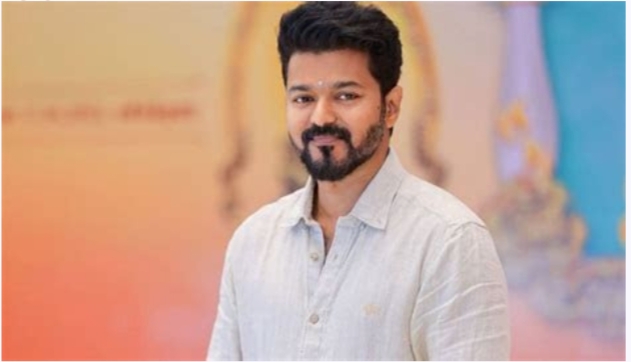
Campaign Without Pedigree: What made Vijay’s campaign extraordinary was its frugality. In a state where politicians flaunt wealth and corruption as proof of viability, Vijay ran on optics of modesty. He didn’t need billboards. He was the billboard. His fan clubs, cultivated over decades of cinema, converted overnight into polling machinery of surgical precision. Where the DMK spent years building patronage, Vijay had already built a religion. His rallies were less political meetings than mass film premieres, with the audience already primed to believe in the hero.
The Collapse of a Dynasty: The DMK’s calculation was simple: Vijay would split the anti‑incumbency vote, leaving crumbs for the ruling party to sweep up. Instead, he inhaled the vote. Urban corridors, semi‑urban towns, and first‑time voters flocked to TVK. The grievances were economic — monopolies, nepotism, the sense that opportunity was commodified. Vijay, himself a product of a family business, was uniquely positioned to campaign against one. The irony was cinematic: the son of a producer dismantling the son of a scriptwriter.
Identity as Superpower: Tamil Nadu politics has always been about identity — caste coalitions, linguistic nationalism, rationalist rhetoric. Vijay refused all of it. He is Christian by faith, agnostic by identity, caste‑free by calculation. In a state where identity is political science, his refusal became a superpower. He was a clean slate onto which voters wrote their aspirations. That blankness was radical. It allowed him to consolidate grievances without distributing them along traditional fault lines.
The Conspiracy Whisper: No Tamil Nadu election is complete without conspiracy theories. The dominant whisper was that the BJP, unable to crack the state and weary of AIADMK’s limitations, quietly bankrolled TVK’s rise. Not to win seats, but to destroy the DMK. A weakened DMK meant the southern firewall against Delhi was breached. Whether true or fevered arithmetic, the theory added a layer of intrigue to Vijay’s victory. It suggested that even outsiders are never entirely outside the system.
Historical Echoes: Political historians reached for comparisons. N. T. Rama Rao in Andhra Pradesh, who swept into power in 1983 with cinematic charisma and Telugu pride. But the comparison is incomplete. NTR built on decades of cinema and clear cultural identity. Vijay built on two years of politics and refused identity altogether. He is a clean slate, a vessel for aspirations. That is both his genius and his governing problem.
The Surviving AIADMK: Amid the wreckage, AIADMK under Edappadi K. Palaniswami survived. Not surged, but survived. Its rural welfare legacy and MGR loyalists kept it afloat. EPS is alive, but he is not the story. The story is Vijay — the disruptor who turned Tamil Nadu’s politics upside down.
Governing the Ledger: Victory is one thing. Governing is another. Vijay needs eight more seats to form a majority. His campaign was built on needing no one. Now he must negotiate with Left parties, caste outfits, and minority groups. Each negotiation will chip away at the pristine outsider image. He campaigned against monopolies, but the levers of economic power remain in the hands of those he defeated. He is anti‑caste in a state where caste arithmetic still decides elections. The clean slate must now become a ledger.
The End of Assumptions: What ended in May 2026 was not just an election. It was the end of an assumption — that the Dravidian frame was the only possible frame. For half a century, analysts, journalists, and politicians believed Tamil Nadu’s politics was immune to outsiders. Vijay proved them wrong. He showed that cinematic charisma, economic grievances, and refusal of identity could dismantle a duopoly. He showed that a single family’s grip on politics and economy could be broken.
A State Elects a Film: Tamil Nadu has always loved cinema. It blurred the line between reel and real, between hero and leader. In 2026, it selected a film. A man who earns more per film than most politicians spend in a career, who built a party in the time it takes others to design a letterhead, has rewritten the script.
The Dravidian dream was eaten by a superstar. The duopoly was dismantled by an outlier. Tamil Nadu, literacy‑driven and economically advanced, chose disruption over dynasty. And in doing so, it reminded India that even the most entrenched orders can be overturned by a story too compelling to ignore.
